
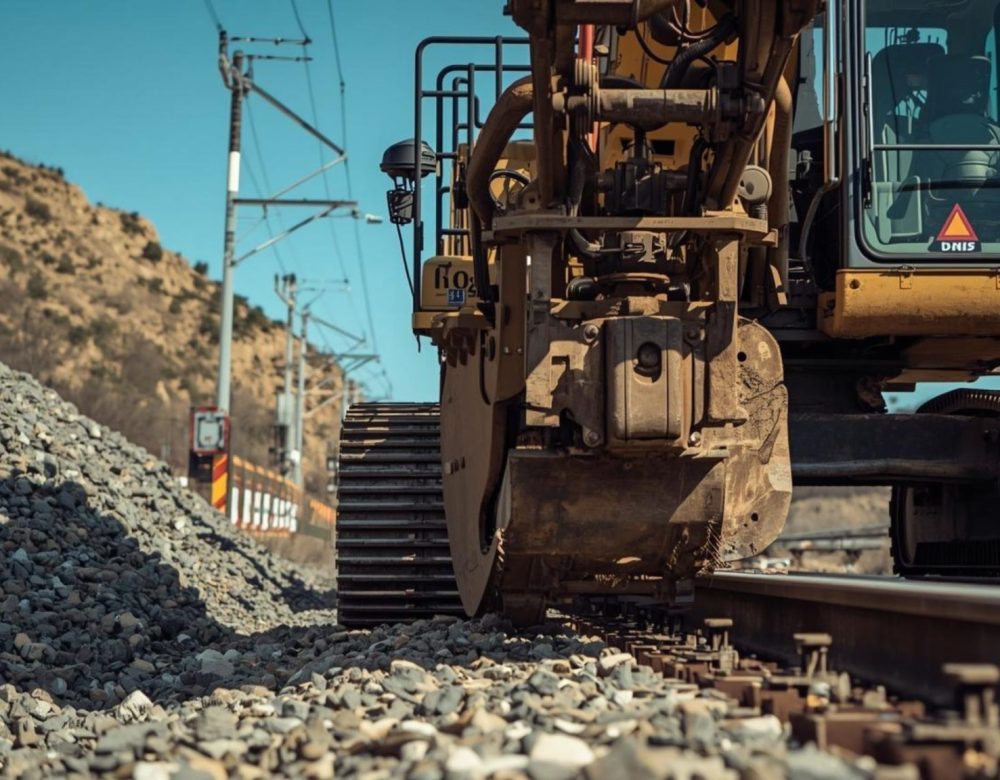
Railroad corridors present a unique legal environment. They are active transportation arteries, heavily regulated spaces, and historically layered property interests all at the same time. When construction projects intersect with these corridors, conflict is not uncommon. That is why understanding railroad right-of-way disputes: what attorneys need to know is essential for counsel representing contractors, project owners, utilities, and even rail operators.
These cases are rarely simple boundary disagreements. They often involve questions like: Who actually had access rights? Was the crossing agreement followed precisely? Did excavation undermine the track structure? Were proper safety protocols implemented before heavy equipment entered the corridor? The answers typically sit at the intersection of property law, construction methodology, engineering standards, and regulatory oversight.
For attorneys, the challenge is not just interpreting contracts or easements. It is building a clear, technically supported narrative that explains what happened in the field and why it matters. The earlier that narrative is shaped, the stronger the position in negotiation, mediation, arbitration, or trial.
Understanding Railroad Right-of-Way Disputes in Construction and Infrastructure Projects
Railroad right-of-way disputes most often arise when a construction activity intersects physically or legally with a rail corridor. This could involve a utility crossing, drainage installation, roadway widening, fiber optic placement, trenchless bore, or staging area access. At first glance, the disagreement may appear to center on property boundaries. In reality, the conflict usually expands to include scope of authorization, safety compliance, and infrastructure impact.
For example, imagine a contractor installing underground utilities near an active rail line. The work plan was approved, but during excavation, the railroad claims that the contractor exceeded authorized limits and compromised ballast support. The contractor maintains that all work stayed within surveyed boundaries and that any settlement was preexisting. What started as a property issue now becomes a technical dispute requiring detailed analysis of equipment positioning, soil conditions, monitoring records, and construction sequencing.
In many cases, the dispute escalates because multiple stakeholders are involved. Rail operators focus on operational safety and infrastructure protection. Contractors prioritize schedule and cost control. Municipal owners may be balancing public interest and infrastructure deadlines. Without a disciplined technical review, conversations can quickly shift from facts to assumptions.
This is where a structured understanding of railroad right-of-way disputes: what attorneys need to know becomes critical. It requires attention not only to deeds and easements, but also to what physically occurred on site.
Legal and Regulatory Framework Governing Rail Corridor Conflicts
Rail corridors are not typical construction sites. They operate under layered legal frameworks that combine state property principles with federal oversight and industry-specific safety expectations. Counsel should anticipate early arguments about jurisdiction, preemption, and the extent of regulatory authority.
Property interests in rail corridors may include fee ownership, easements, licenses, and crossing agreements that date back decades. The language in these documents often reflects older construction practices and may not clearly address modern trenchless technologies or utility density. Interpreting that language requires both legal precision and practical understanding of construction realities.
Federal Oversight and Jurisdictional Considerations
When an active rail line is involved, regulatory compliance becomes central. Rail operators often assert strict standards for access, work windows, protective measures, and emergency response planning. Attorneys should evaluate whether the appropriate approvals were obtained and whether the project team adhered to required procedures.
Questions that frequently arise include:
- Were required notifications made before entering the corridor?
- Was flagging or protective oversight provided where mandated?
- Did the contractor follow the approved work plan exactly?
- Was any deviation formally authorized?
These questions may determine not only liability but also credibility in ADR or court proceedings.
Easements, Title History, and Property Rights
Railroad easement disputes often hinge on subtle distinctions. Does the document grant exclusive use? Does it permit third-party crossings? Are there width limitations or depth restrictions? Attorneys frequently discover that historical plats and surveys do not align neatly with current construction drawings.
In utility crossing disputes, compliance with crossing agreements becomes pivotal. Even minor deviations in bore depth, casing installation, or setback distance may be cited as violations. However, proving that such deviations caused actual damage requires careful technical evaluation. It is not enough to identify a discrepancy. The question is whether that discrepancy materially affected rail infrastructure.
Construction Activities That Trigger Railroad Right-of-Way Disputes
Many rail corridor conflicts originate in construction means and methods. Heavy equipment operations near active track carry inherent risk. When something goes wrong, or when damage is alleged, the spotlight turns to how the work was executed.
Heavy Equipment Operations Near Active Rail Lines
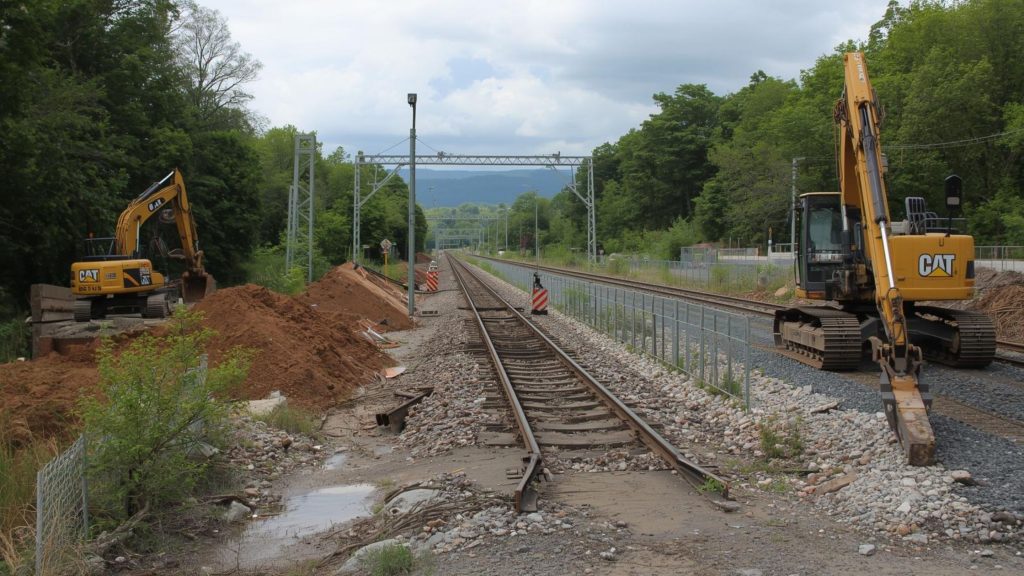
Equipment such as excavators, backhoes, skid steers including Bobcat units, and drilling rigs are common in corridor work. The physical footprint of this equipment, along with vibration and load transfer, can become focal points in a dispute.
Consider the following factors that are often examined:
- Proximity of excavation to the track structure
- Depth of cut and support of adjacent soils
- Potential undermining of ballast or subgrade
- Compaction methods and vibration impact
- Equipment access routes and staging locations
A persuasive case typically involves correlating daily reports, equipment logs, and site photographs with engineering analysis. Was the alleged damage consistent with the type of equipment used? Could the observed condition have developed over time independent of the project? These are not theoretical questions. They require disciplined technical reconstruction.
Trenchless and Utility Installations
Trenchless installations add another layer of complexity. Directional drilling under railroads or installing casings beneath track requires precise alignment control and geotechnical awareness. When settlement or voids are alleged, attorneys must examine bore logs, steering data, fluid pressures, and monitoring records.
In some cases, rail operators may assert that drilling fluid migration or inadvertent returns compromised subgrade conditions. Contractors may counter that all parameters were within acceptable tolerances. Without detailed review of project documentation and soil behavior, such disputes can devolve into speculation.
Safety and Compliance Failures
Safety issues can intensify exposure quickly. Allegations of inadequate coordination, missing flag protection, or unauthorized work windows can shift the focus from technical disagreement to perceived recklessness. Even if no incident occurred, failure to adhere to documented safety protocols may influence liability analysis and settlement posture.
For attorneys, early review of safety plans, job hazard analyses, and coordination logs is often invaluable. It helps establish whether the narrative will revolve around technical causation, procedural compliance, or both.
The Role of Construction Alternative Dispute Resolution in Railroad Conflicts
Rail corridor disputes are expensive and disruptive. Extended litigation can strain relationships between contractors, owners, and rail operators. As a result, Construction Alternative Dispute Resolution often becomes the preferred path.
Effective Alternative Dispute Resolution depends on clarity. Mediation and arbitration are more productive when the technical issues are distilled into understandable, evidence-based conclusions. That is why early technical analysis can significantly influence outcomes.
For matters involving trenchless work or heavy equipment operations, specialized evaluation may be essential. Services such as trenchless construction alternative dispute resolution can support attorneys in preparing clear, defensible presentations of causation and damages.

Mediation vs. Arbitration in Rail Infrastructure Disputes
In mediation, parties often seek a practical resolution that accounts for risk, cost, and operational continuity. A well-supported technical assessment can narrow disputed issues and establish a reasonable damages framework.
Arbitration, on the other hand, may require more formal expert testimony. Clear visuals, documented methodology, and consistent analysis are essential. Counsel who anticipate this early are typically better prepared for the procedural demands.
Technical Evidence and Expert Witness Testimony
When testimony becomes necessary, experience in construction operations and corridor conditions can make a substantial difference. Expert evaluation often includes site inspection, review of plans and daily records, equipment capability analysis, and cost assessment.
Attorneys may benefit from engaging support aligned with heavy equipment litigation and trenchless expertise, including heavy equipment litigation support and trenchless construction expert witness services.
Key Litigation Challenges Attorneys Must Anticipate
Causation remains the central challenge in most railroad right-of-way disputes. Rail infrastructure naturally deteriorates over time. Weather, vibration from daily operations, and maintenance cycles all influence track condition. Distinguishing project-related impact from preexisting conditions requires more than opinion. It requires analysis rooted in documentation and engineering principles.
Documentation gaps are another recurring issue. In corridor projects, records may include contractor logs, subcontractor notes, survey data, rail coordination forms, and permit approvals. If these records are incomplete or inconsistent, opposing counsel may exploit the weaknesses.
Damages evaluation also deserves careful attention. Claims may include repair costs, standby time, operational disruption, and schedule delay. Each element must be tested against project realities and standard estimating practices. Without structured review, damages discussions can become inflated and detached from measurable impact.
Why Early Expert Involvement Strengthens Railroad Right-of-Way Cases
Early expert involvement often changes the trajectory of a case. A prompt site review, document assessment, and technical evaluation can clarify issues before positions harden. It may also identify alternative explanations that shift negotiation dynamics.
In complex matters involving excavation or trenchless crossings, engaging technical support early can improve both compliance documentation and litigation readiness. It allows counsel to present a coherent engineering narrative rather than reacting defensively to allegations.
Ultimately, railroad right-of-way disputes: what attorneys need to know is that success depends on integrating legal strategy with technical clarity. When the story of what happened in the field is supported by documentation, analysis, and credible expertise, resolution becomes more attainable.
Conclusion: Practical Guidance for Attorneys Handling Railroad Right-of-Way Disputes
Rail corridor conflicts demand more than traditional property analysis. They require a balanced understanding of construction methods, heavy equipment operations, regulatory compliance, and cost evaluation. Attorneys who approach these cases holistically are better equipped to protect their clients’ interests.
If your matter involves rail corridor excavation, trenchless installation, alleged infrastructure damage, or ADR strategy, experienced technical support can provide clarity. To discuss your case and evaluate next steps, contact Discovery Experts for a confidential consultation.
